Swimming Kickboard for Adults: How to Choose the Right Board
September 9, 2026
A swimming kickboard for adults looks like one of the simplest pieces of pool equipment: a buoyant board that you hold while your legs do the work. Yet choosing and using one well involves several variables, including board size, buoyancy, hand position, body position, kicking technique, swimming ability, and the purpose of the drill.
For adult swimmers, a kickboard can be useful for isolating leg-focused practice, simplifying certain drills, and adding variety to structured pool sessions. But it should not be viewed as a device that automatically improves swimming technique. The way you use the board matters at least as much as the board itself.
Research on swimming biomechanics also provides useful context. Studies examining kicking in front crawl show that the legs contribute to swimming performance and interact with body position and overall propulsion. However, research involving competitive or elite swimmers should not be translated into universal performance promises for recreational adults.
This guide separates what research can tell us from what should be evaluated practically when choosing a kickboard.
What Does a Swimming Kickboard Actually Do?
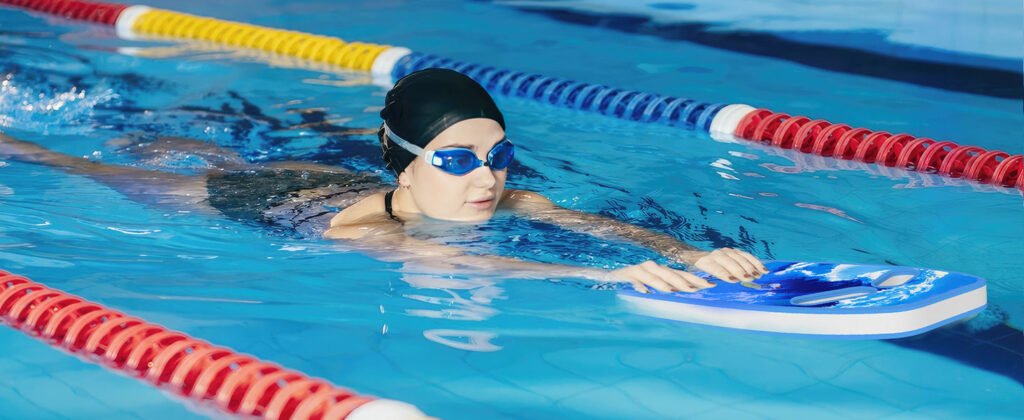
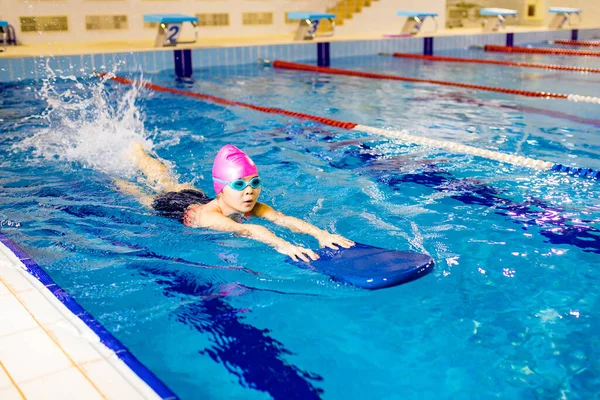
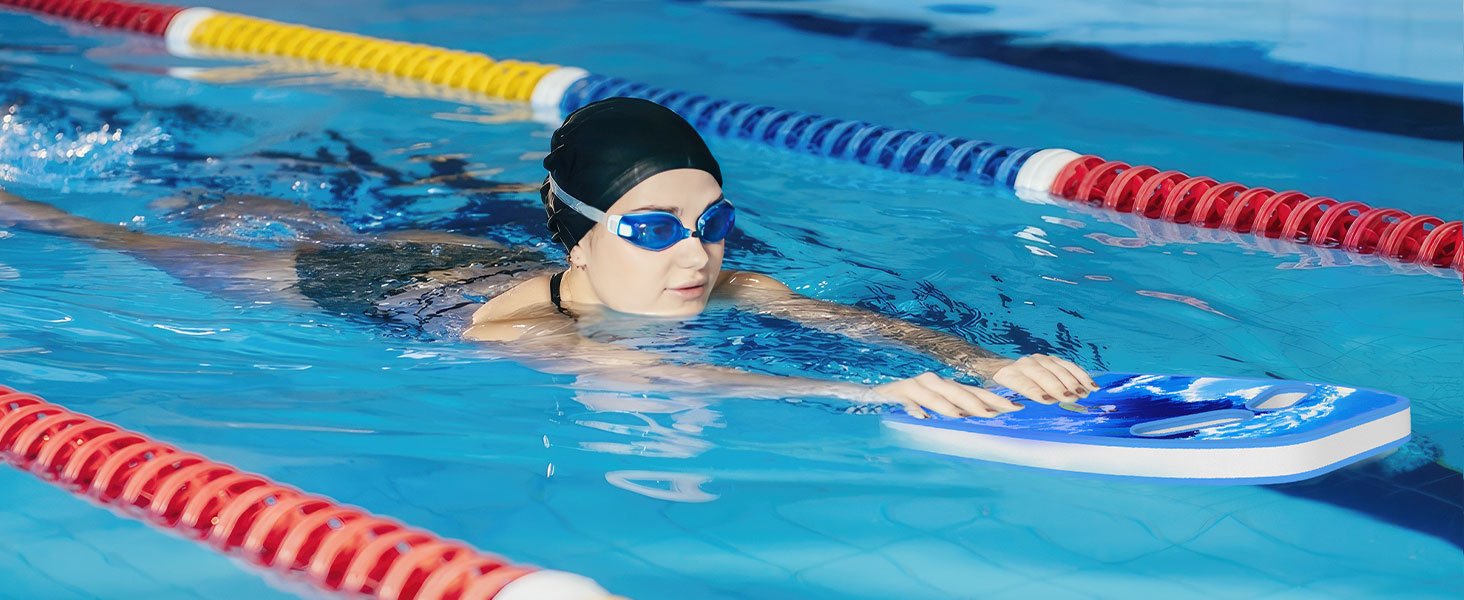
A conventional kickboard provides buoyant support for the upper body while allowing the swimmer to emphasize kicking. By reducing or removing normal arm strokes during a drill, it makes it easier to concentrate attention on the legs.
That makes kickboards useful for several different purposes:
isolating kicking during a swimming set;
practicing a more consistent kicking rhythm;
adding leg-focused intervals to a workout;
allowing swimmers to pay closer attention to lower-body movement;
providing variety within structured swim training.
Importantly, a kickboard does not reproduce normal whole-stroke swimming perfectly. Holding a board changes what the arms are doing and can alter body position. Kickboard drills should therefore be understood as training drills, not exact substitutes for swimming a complete stroke.
FACT BOX: Research supports the idea that kicking is a meaningful component of front-crawl swimming, but its role is more complex than simply providing additional forward thrust. Studies have examined relationships among kicking, swimming velocity, trunk position, drag, and upper-body propulsion.
What Research Says About the Role of the Legs in Swimming
It is tempting to describe kickboard training with broad statements such as “stronger kicks make you faster.” The evidence calls for a more careful interpretation.
A 2026 biomechanics study involving eight male swimmers compared whole front crawl with an arm-only condition across several stroke frequencies. Swimming velocity was approximately 16.9–18.5% higher in the whole-stroke condition, while stroke length was 17.3–19.5% longer. Interestingly, the researchers did not find a difference in hand propulsion between conditions, illustrating that the relationship between kicking and whole-stroke performance cannot be reduced to a single mechanism.
Another study involving seven male swimmers examined front crawl across a range of swimming velocities. The researchers concluded that kicking had a positive effect on reducing pressure drag acting on the trunk, allowing a given velocity to be achieved with less hand propulsive force. The effect was particularly notable at lower velocities in that experimental setting.
Research Finding
What It Suggests
What It Does Not Prove
Whole-stroke swimming was faster than an arm-only condition in one small biomechanics study.
Kicking contributes meaningfully to complete front-crawl performance.
Kickboard training alone will produce a specific improvement in swimming speed.
Kicking has been associated with changes in trunk position and pressure drag.
The legs can contribute to swimming mechanics beyond direct propulsion.
Every recreational swimmer needs the same kicking technique or training volume.
Kick-only swimming creates a distinct physiological and mechanical task.
Kick sets can provide a different training stimulus from normal swimming.
Kick-only swimming should replace whole-stroke practice.
The practical message is straightforward: the kick matters, but kickboard performance and whole-stroke swimming performance are not the same thing.
Kick-Only Swimming Is Not Simply Regular Swimming Without the Arms
One useful study compared swimming, pulling, and kicking over 200 meters in 20 elite swimmers. At the tested intensities, the researchers found substantial differences between upper- and lower-limb contributions to velocity and metabolic cost. The lower limbs accounted for a greater percentage of metabolic cost than their relative contribution to velocity in those experimental conditions.
That finding is particularly useful when thinking about kickboard workouts. A kick-only set may feel disproportionately demanding even when your speed is much lower than during normal swimming.
RESEARCH SUMMARY: In a study of 20 elite swimmers, lower-limb work represented a smaller relative contribution to velocity than upper-limb work while accounting for a comparatively large share of metabolic cost at the tested intensities. These results come from elite swimmers and controlled 200-meter trials, so they should not be treated as exact predictions for recreational adults.
If you are surprised by how demanding a kickboard interval feels, slower progress through the water does not necessarily mean the drill is doing very little. Kick-only swimming is simply a different task from whole-stroke swimming.
Large vs. Compact Kickboards for Adults
There is no scientifically established universal board size that is best for every adult swimmer. Product dimensions also vary by manufacturer, so an article should not invent an “ideal” measurement.
Instead, size should be evaluated according to buoyancy, handling, body position, storage, and training purpose.
Factor
Larger Traditional Board
More Compact Board
Buoyant surface
Generally provides more board area
Generally provides less board area
Handling
May feel substantial and easy to hold for some users
May feel less cumbersome for some swimmers
Travel and storage
Requires more space
Usually easier to pack and store
Body positioning
Depends on board design and how it is held
Depends on board design and how it is held
Best choice
Adults who prefer a conventional kickboard feel
Adults prioritizing compactness or a less bulky training tool
Notice what the table does not say: that a larger board is automatically better for beginners or a smaller one is automatically better for advanced swimmers. Those claims would be too broad.
An adult swimmer should instead ask: Can I hold this board comfortably while maintaining the body position required for my drill?
Buoyancy Matters, but More Is Not Automatically Better
A kickboard needs sufficient buoyancy for its intended purpose, but maximizing flotation should not necessarily be the goal.
Buoyancy depends on characteristics such as the board’s volume, shape, and material. Two products that look similar may feel different in the water.
For an adult buyer, useful questions include:
Does the board provide comfortable support for the intended drill?
Does it feel excessively bulky?
Can you maintain a comfortable grip?
Does the board encourage a position that works for your training goal?
Can you control it easily when changing direction or stopping?
Because manufacturers use different constructions and materials, compare actual product information rather than assuming all foam kickboards behave identically.
Shape and Hand Position Can Change the Experience
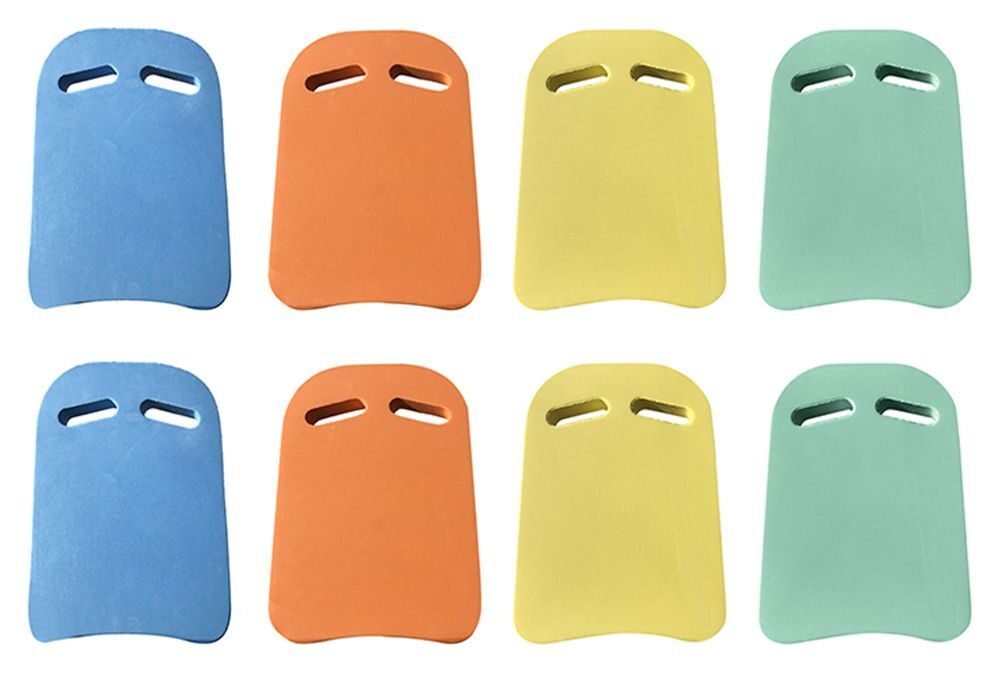
Adult kickboards are available in traditional rectangular or rounded profiles as well as more contoured designs. Some include dedicated hand openings; others rely on holding the sides or front of the board.
No single shape is universally superior.
Design Feature
Potential Advantage
What to Check
Traditional broad shape
Familiar, straightforward design
Whether the width and grip feel comfortable
Hand openings
Provides defined grip locations
Whether the openings fit your hands comfortably
Contoured shape
May feel less bulky depending on the design
Whether the shape suits your preferred drills
Compact profile
Easier transportation and storage
Whether it provides the support you expect
Textured surface
May make wet handling easier
Comfort and durability during repeated use
Hand position also affects posture. Holding a conventional board far out in front can place the arms in an extended position and influence how you carry your head and upper body.
If a particular grip produces discomfort, do not assume discomfort is simply part of effective training. A coach can help you modify the drill or select another training tool when appropriate.
Body Position Is More Important Than Simply Moving Faster
Good swimming depends heavily on how the body interacts with the water. USA Swimming’s developmental framework, for example, emphasizes streamlined body positioning and progressive development of kicking skills rather than treating kicking as an isolated question of effort.
With a kickboard, recreational swimmers sometimes become so focused on reaching the other end of the pool that they overlook position. They may lift the head excessively, tense the shoulders, or produce large uncontrolled leg movements.
A more useful approach is to pay attention to:
controlled body alignment;
a kick appropriate to the stroke being practiced;
comfortable head and neck positioning;
consistent rather than frantic movement;
the specific objective of the drill.
FACT BOX: A kickboard isolates part of swimming technique; it does not recreate complete swimming mechanics. Use kickboard drills alongside appropriate whole-stroke practice when your goal is broader swimming development.
Flutter Kick, Dolphin Kick, and Breaststroke Kick Are Different Skills
The word “kick” can make swimming leg work sound like one generic movement. It is not.
Different strokes use different kicking patterns. USA Swimming’s rules, for example, distinguish the simultaneous leg movements required in butterfly and breaststroke from the kicking possibilities in other strokes.
This matters when using a kickboard because the board itself does not teach correct mechanics.
Kick Type
General Training Context
Important Consideration
Flutter kick
Commonly associated with freestyle/front crawl and backstroke training
Technique and body position matter more than simply kicking harder
Dolphin kick
Used in butterfly and underwater swimming contexts
Requires coordinated movement rather than isolated frantic leg action
Breaststroke kick
Specific to breaststroke technique
Movement pattern differs substantially from flutter and dolphin kicking
If you are learning a stroke rather than simply adding exercise variety, instruction from a qualified swim coach is much more valuable than trying to reverse-engineer technique from the shape of a kickboard.
How Should Adults Choose a Swimming Kickboard?
Because reliable evidence does not establish one ideal kickboard specification for all adults, the buying decision should be based primarily on intended use and practical characteristics.
Start with these criteria:
Training goal: Are you practicing technique, adding kick intervals, or simply looking for structured pool exercise?
Board dimensions: Check the manufacturer’s actual measurements rather than assuming “adult” guarantees a particular size.
Buoyancy: Look for a board intended for adult swimming and your intended type of use.
Grip: Consider whether you prefer side grips, a traditional edge, or dedicated hand openings.
Material: Check the manufacturer’s description and care instructions.
Comfort: Edges, surface texture, thickness, and grip position can influence how a board feels.
Durability: Consider repeated exposure to pool water, transportation, and storage.
Portability: A compact board may be useful if you regularly carry equipment to and from the pool.
Storage: Make sure the board can dry and be stored appropriately after use.
Features should be judged by whether they solve a real problem for you. Hand openings are useful only if you like their position. Extra size is useful only if it contributes to the support and handling you want.
Beginner, Recreational, and Experienced Swimmers May Want Different Things
Skill level influences how a kickboard is used, but it should not be treated as a rigid product classification.
User
Likely Priority
Useful Approach
Adult beginner
Comfort, control, straightforward handling
Focus on basic technique with appropriate instruction
Recreational swimmer
Versatility and convenience
Use kick sets as one component of a varied swim session
Fitness swimmer
Structured leg-focused intervals
Choose a board that works comfortably with regular training
Experienced swimmer
Drill-specific requirements
Select equipment according to the intended training objective
Beginners should also understand an important limitation: a kickboard is a training aid, not a water-safety device. It does not replace swimming instruction, appropriate supervision, or an approved flotation device where one is required.
How Hard Should a Kickboard Workout Be?
There is no evidence-based universal kickboard workout duration or distance that suits every adult. Swimming ability, conditioning, technique, age, training history, and workout goals vary too much for one number to be appropriate.
Research does show that kick-only swimming can impose meaningful physiological demands. A recent study involving club-level swimmers, for example, included a maximal-effort 200-meter legs-only condition performed with a kickboard and found measurable respiratory muscle fatigue after the effort. That is an experimental maximal-effort protocol—not a recommended workout for the average adult—but it reinforces that kick-only swimming can be demanding.
RESEARCH INTERPRETATION: Do not use competitive or laboratory kick sets as ready-made workout prescriptions. Research protocols are designed to answer scientific questions and may involve trained participants and maximal efforts.
For recreational training, begin at a manageable level and increase volume or intensity gradually. Quality of movement should remain a priority.
Common Mistakes That Reduce the Value of Kickboard Training
A kickboard is simple enough that poor habits can easily go unnoticed.
Kicking as hard as possible on every length. Effort and technique are not interchangeable. Different drills have different purposes.
Choosing a board solely because it is large. More board is not automatically more useful. Handling and body position matter.
Ignoring upper-body discomfort. Extended kickboard positions may not feel comfortable for everyone. Modify or stop the drill if necessary.
Comparing kick speed directly with normal swimming speed. Kick-only and whole-stroke swimming are mechanically different tasks.
Using the board as a flotation safety device. A swimming kickboard is training equipment and should not be relied upon as a substitute for appropriate water-safety equipment.
Assuming equipment will correct technique. The board can isolate a movement, but feedback and instruction are still important when learning proper swimming skills.
Choosing a Kickboard Based on Evidence and Practical Use
A swimming kickboard for adults does not need complicated technology to be useful. Its value comes from giving you a practical way to isolate kicking and incorporate leg-focused drills into swimming sessions.
The research provides a useful broader lesson: kicking contributes to swimming performance, interacts with body position and drag, and can create a substantial training demand. At the same time, studies involving small groups of trained swimmers cannot tell us that one kickboard size, shape, workout distance, or kicking strategy is universally best.
When buying a board, concentrate on factors you can evaluate directly: appropriate size, comfortable grip, sufficient buoyancy, manageable shape, durable construction, and compatibility with the drills you actually intend to perform.
Then use it with a clear purpose. A few controlled kick lengths performed with attention to technique can be more meaningful than simply holding a board and trying to cross the pool as quickly as possible.
Safety Note: Kickboards do not replace swimming ability, professional instruction, lifeguard supervision, or approved personal flotation devices. Swim in an environment appropriate for your ability, follow pool rules, and stop if you experience unusual pain, dizziness, severe shortness of breath, or other concerning symptoms.