Best Kickboard Exercises for Swimming: Practical Drills and Expert Tips
October 14, 2026
A swimming kickboard is simple equipment, but the way you use it can dramatically change the purpose of a workout. One swimmer may use a board to practice a controlled flutter kick, another may use it for short leg-focused intervals, while a beginner may need to concentrate primarily on body position and confidence in the water.
So what are the best kickboard exercises for swimming, and how should you choose between them?
This article uses a general expert Q&A format based on established swimming-training principles. The “Expert” represents a general swimming instruction and training perspective rather than a specific named coach or a fabricated interview.
What Is the Main Purpose of a Kickboard Exercise?
Question: What should a swimmer actually be trying to accomplish when using a kickboard?
Expert: Start with a purpose rather than simply deciding to swim several lengths with a board. Kickboards are commonly used to reduce the involvement of the arms so that you can focus more attention on kicking.
Depending on the swimmer, a kickboard drill might emphasize:
kicking rhythm;
body position;
leg-focused exercise;
technique awareness;
controlled changes in effort;
specific stroke-related kicking patterns.
A kickboard is not automatically a technique-correction device. It gives you an environment in which you can concentrate on part of the swimming movement, but you still need to perform that movement appropriately.
Before starting a set, ask yourself one question: What am I practicing during these lengths?
What Is the Best Kickboard Exercise for Beginners?
Question: If someone is relatively new to swimming, which kickboard drill should come first?
Expert: A simple supported flutter-kick drill is often a practical starting point for someone who already has appropriate basic water skills.
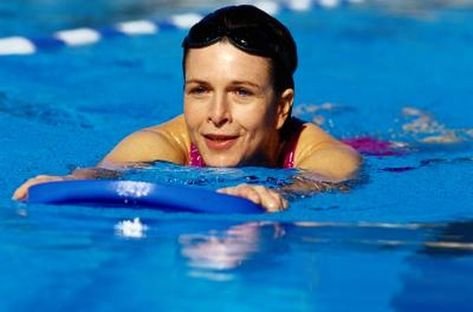
Hold the board securely in front of you, maintain a comfortable body position, and practice a controlled flutter kick. The goal is not maximum speed. Pay attention to maintaining a repeatable rhythm without turning the movement into exaggerated kicking.
A beginner should focus on:
comfortable hand placement;
stable board control;
a manageable head position;
controlled leg movement;
steady breathing;
staying relaxed rather than racing the length.
If maintaining position with the board is difficult, instruction from a qualified swim teacher or coach can be more useful than simply repeating more lengths.
And remember: a kickboard is a training aid, not a personal flotation device or substitute for swimming ability and appropriate supervision.
How Should You Perform a Basic Flutter-Kick Drill?
Question: What does a basic kickboard flutter-kick exercise look like?
Expert: Start in a position appropriate to your swimming ability and the pool environment. Hold the board without squeezing it unnecessarily and extend it comfortably in front of you.
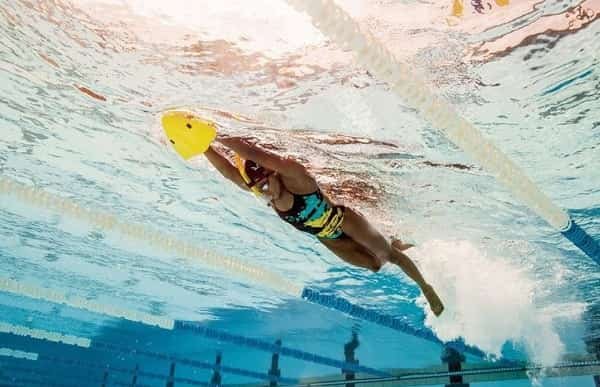
Then concentrate on a continuous, controlled flutter kick.
Hold the board securely.
Establish a comfortable horizontal position.
Begin with a relaxed kicking rhythm.
Avoid deliberately making each kick as large as possible.
Maintain control as fatigue increases.
Rest when technique begins to deteriorate.
The drill can be performed at different effort levels depending on your training goal, but beginners benefit from learning control before trying to increase speed.
Should Flutter Kicks Be Big or Small?
Question: Many beginners make very large kicks because they think bigger movements create more power. Is that a good strategy?
Expert: More movement does not automatically mean better movement. Excessively large kicking can make it harder to maintain a consistent body position and rhythm.
Instead of thinking “kick as big as possible,” think about controlled, continuous movement. Your kick should fit the stroke and the objective of the drill.
If you are splashing dramatically but barely maintaining a repeatable rhythm, reduce the effort and concentrate on control.
What Is a Good Kickboard Exercise for Building a Consistent Rhythm?
Question: What if my main problem is that my kicking becomes inconsistent?
Expert: Use easy, controlled lengths where maintaining rhythm is more important than finishing quickly.
You can divide the pool length mentally into sections. During each section, concentrate on keeping the kick similar rather than progressively increasing effort.
For example:
First section: settle into a comfortable rhythm;
Middle section: maintain the same controlled movement;
Final section: resist the temptation to sprint if technique is deteriorating.
This is intentionally simple. Sometimes a swimmer gains more from repeating a technically manageable drill than from adding complicated variations.
Can You Use a Kickboard for Faster Intervals?
Question: Does every kickboard drill need to be slow and technique-focused?
Expert: No. More experienced swimmers can use kickboards for harder leg-focused intervals when that fits their training program.
The important distinction is between purposeful intensity and uncontrolled effort.
A faster interval can be useful when you already understand the kicking pattern and can maintain reasonable technique as effort increases. If faster kicking immediately causes your body position and movement to fall apart, reducing the intensity may produce a more useful training set.
Intensity can be varied without assuming that every length must be maximal.
What Is an Easy-to-Hard Kickboard Drill?
Question: Is there a simple way to add intensity changes without creating a complicated workout?
Expert: Yes. An easy-to-moderate progression can help you learn to change effort while keeping the movement controlled.
An illustrative sequence could be:
Begin at an easy, comfortable effort.
Settle into a repeatable kick.
Gradually increase effort while maintaining control.
Return to an easier pace before technique deteriorates.
This is a drill concept rather than a universal prescription for distance, duration, or intensity. Those variables should reflect your swimming ability and training plan.
Can You Practice Breaststroke Kick With a Kickboard?
Question: Is a kickboard useful only for freestyle flutter kick?
Expert: No. A board can also be incorporated into breaststroke kick practice, provided the swimmer understands the appropriate movement pattern.
This is important because breaststroke kick is mechanically different from flutter kick. You should not approach it as simply a slower or wider version of freestyle kicking.
When practicing, focus on controlled repetition of the movement rather than trying to force maximum propulsion from every kick.
If you are learning breaststroke technique for the first time, qualified instruction is especially valuable. Repeating an incorrect movement for many lengths can reinforce the very habit you are trying to change.
Can You Practice Dolphin Kick With a Kickboard?
Question: What about dolphin kick?
Expert: Kickboards can be incorporated into certain dolphin-kick drills, but this is generally more appropriate for swimmers who already understand the basic movement.
Dolphin kick involves coordinated movement rather than simply bending and straightening the knees forcefully. The board changes your arm position and can influence how the drill feels, so it should be treated as one training variation rather than a perfect representation of full-stroke butterfly.
As with other kickboard exercises, quality matters more than accumulating repetitions with poor mechanics.
Can You Do Backstroke Kick With a Kickboard?
Question: Can the kickboard be used while kicking on your back?
Expert: Yes, swimmers sometimes incorporate a kickboard into backstroke-oriented kicking drills, although the way the board is held may differ from a standard face-down kickboard drill.
The exact setup should match the swimmer’s ability and coaching objective. The important point is that the board should not make you feel unstable or interfere with safe awareness of your surroundings.
For swimmers learning backstroke, direct instruction is preferable to guessing at body and board positioning.
What Is a Good Kickboard Exercise for Body-Position Awareness?
Question: Can a kickboard help me understand how my body sits in the water?
Expert: It can help you become more aware of position, but remember that holding a kickboard changes normal swimming mechanics.
Try an easy kick where speed is deliberately de-emphasized. Pay attention to:
how high or low the hips feel;
whether the head is excessively lifted;
whether the shoulders feel unnecessarily tense;
whether the kick remains controlled;
how changing effort affects your overall position.
The purpose is observation. You are learning what changes when you adjust posture and kicking effort.
Then compare that awareness with whole-stroke swimming rather than assuming the kickboard position is the exact position you should reproduce without the board.
Why Does My Neck Get Tired When I Use a Kickboard?
Question: My legs are supposed to be doing the work, but sometimes I notice my neck and shoulders more than my legs. Why?
Expert: Your upper-body position may be contributing. Holding a conventional kickboard out in front while keeping the head raised can become uncomfortable for some swimmers.
First, check whether you are unnecessarily tensing your shoulders or lifting your head more than the drill requires.
You can also review:
where your hands are positioned;
how far the board is held from the body;
whether you are gripping it excessively;
whether the drill is appropriate for you;
whether another drill variation would be more comfortable.
Do not continue forcing an uncomfortable position simply because it is a traditional kickboard drill. Persistent or significant pain deserves appropriate evaluation.
Why Do My Legs Get Tired So Quickly With a Kickboard?
Question: I can swim several lengths normally, but kickboard lengths feel surprisingly difficult. Is that unusual?
Expert: Not necessarily. Kick-only swimming is a different task from complete swimming. By reducing arm involvement, you are asking the lower body to take on a much more prominent role in moving you through the water.
The first response should not automatically be to kick harder.
Check whether:
your kick is unnecessarily large;
you started too fast;
your body position is creating extra difficulty;
you are holding excessive tension;
your kick set is too demanding for your current conditioning.
Shorter, better-controlled sets can be more productive than struggling through long distances with deteriorating technique.
Should I Bend My Knees When Kicking?
Question: Should the legs stay completely straight during flutter kick?
Expert: Avoid thinking in absolutes such as “never bend the knees.” Human swimming involves coordinated movement through multiple joints.
The more useful concern for many recreational swimmers is avoiding an exaggerated bicycle-like kicking action where the knees dominate the movement.
If you are unsure about your mechanics, having a coach observe you is far more informative than trying to judge the movement entirely from what you feel while holding a board.
Is a Kickboard Good for Learning How to Swim?
Question: Can a beginner simply buy a kickboard and use it to teach themselves swimming?
Expert: A kickboard can be a useful training aid within swimming instruction, but it should not be treated as a substitute for learning water safety and swimming skills.
A person who is not confident in the water needs an appropriate environment, supervision, and instruction. A kickboard can slip away, move unexpectedly, or be released. It is not designed to function as a safety flotation device.
Beginners should use kickboards according to their ability and the guidance of a qualified instructor when appropriate.
Safety Note: Never rely on a kickboard to keep a non-swimmer safe in the water.
Should I Use a Large or Small Kickboard for Exercises?
Question: Does board size change the exercise?
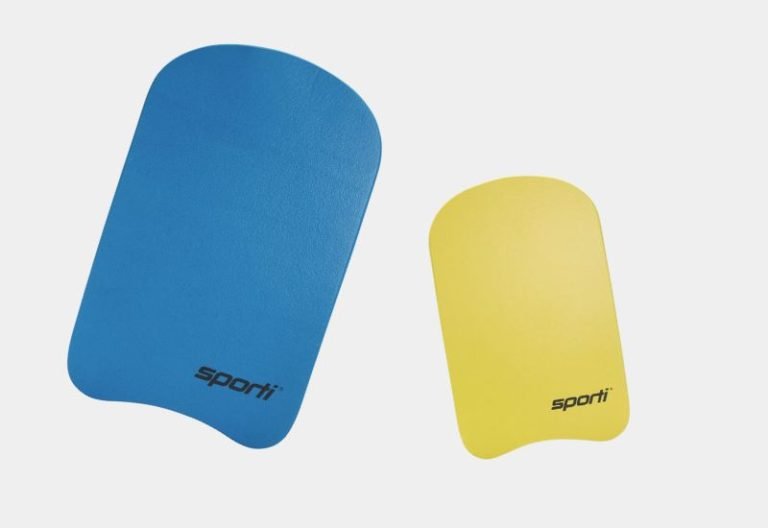
Expert: Size, shape, buoyancy, and grip can all affect how a board feels. A larger traditional board may provide a different amount of support and handling experience from a compact board.
There is no universal board size that is best for every adult or every drill.
Board Characteristic
What to Consider
Larger profile
May provide more surface area but can feel bulky to some swimmers
Compact profile
Can be easier to carry and store but may feel different in the water
Hand openings
Can provide defined grip positions
Traditional edges
Allow different hand positions depending on the board
Surface texture
Can influence wet-hand grip and comfort
Choose based on your training needs, comfort, swimming ability, and the drills you intend to perform rather than assuming the biggest board is automatically the best.
Do I Need a Different Kickboard for Different Exercises?
Question: Should I own several kickboards for different drills?
Expert: Most recreational swimmers do not need a collection of boards just to create useful workouts.
A comfortable general-purpose board can support a variety of kicking drills. Specialized shapes may become useful when you have a specific training reason for choosing them.
Before buying another board, ask whether the new design solves a real problem:
Is your current board uncomfortable?
Is it too large to transport?
Do you want different hand-placement options?
Does your coach recommend a particular style for a specific drill?
If not, changing the workout may be more useful than changing the equipment.
How Can I Make Kickboard Exercises More Challenging?
Question: Once basic kickboard exercises become comfortable, what should I change?
Expert: Difficulty can be adjusted in several ways without immediately adding more equipment.
You might change:
effort level;
distance;
number of repetitions;
rest between efforts;
kick type;
technical focus;
the way the kick set fits into the complete swim workout.
Change one variable for a reason. Increasing distance, reducing rest, and increasing intensity simultaneously makes it harder to understand what is actually affecting the quality of the set.
What Is a Simple Kickboard Workout for Recreational Swimmers?
Question: Can you give an example without pretending one workout fits everyone?
Expert: Yes. Think in terms of a framework rather than mandatory distances.
Phase
Example Focus
Purpose
Warm-up
Easy whole-stroke swimming
Prepare gradually for activity
Kick Drill 1
Easy controlled flutter kick
Establish rhythm
Kick Drill 2
Moderate controlled effort
Add a manageable challenge
Technique Drill
Stroke-specific kick appropriate to ability
Focus attention on movement quality
Whole Stroke
Return to normal swimming
Reconnect isolated practice with complete swimming
Easy Finish
Comfortable swimming
Finish at a manageable effort
The appropriate distance and number of repetitions depend on swimming ability, conditioning, session goals, and coaching plan.
Is It Better to Kick Faster or Practice Technique?
Question: If I want to become a better swimmer, should I concentrate on speed or technique?
Expert: They should not be treated as permanent opposites. Eventually, swimmers need to maintain useful movement while effort increases.
But if increasing speed causes technique to deteriorate immediately, simply trying harder may not solve the problem.
A practical progression is:
learn the movement at manageable effort;
make it repeatable;
increase the challenge gradually;
observe whether technique remains controlled;
return to easier practice when quality falls apart.
That creates a stronger foundation than treating every kickboard set as a race.
How Often Should Kickboard Exercises Be Included?
Question: Should swimmers do kickboard exercises during every pool session?
Expert: There is no universal frequency that every recreational swimmer needs.
Kickboard work is one training option among many. The appropriate amount depends on your goals, swimming ability, overall training volume, technique, and what else you are doing in the pool.
If your workout becomes dominated by isolated kicking even though your primary goal is improving complete swimming, reconsider the balance of your session.
The board should support the training objective rather than become the objective itself.
What Are the Most Common Kickboard Exercise Mistakes?
Question: Which errors should swimmers watch for?
Expert: Several appear repeatedly in recreational kickboard practice:
Starting too hard: The first length becomes a sprint and later technique deteriorates.
Making the kick excessively large: Bigger movement is mistaken for better propulsion.
Holding excessive upper-body tension: Hands, shoulders, and neck become unnecessarily tense.
Ignoring body position: The swimmer focuses entirely on the legs.
Doing excessive volume: More kickboard lengths are assumed to be automatically better.
Using the same drill for every goal: Technique, conditioning, and stroke-specific practice are different objectives.
Never returning to whole-stroke swimming: Isolated practice is not integrated into complete swimming.
Treating the board as safety equipment: A training kickboard is not an approved flotation device.
Practical Takeaways
Question: If readers remember only a few things about the best kickboard exercises for swimming, what should they be?
Expert: Keep the equipment simple and make the purpose of each exercise clear.
✓ Start with controlled flutter-kick practice if it suits your ability.
✓ Choose a drill based on what you want to practice.
✓ Prioritize rhythm and control before increasing intensity.
✓ Use breaststroke or dolphin-kick drills only when you understand the appropriate movement.
✓ Pay attention to body, head, neck, and shoulder position—not only the legs.
✓ Use shorter sets when technique deteriorates during longer efforts.
✓ Combine isolated kick work with whole-stroke swimming when appropriate.
✓ Choose a kickboard based on comfort and intended use rather than size alone.
✓ Seek qualified instruction when learning unfamiliar swimming techniques.
✓ Never treat a kickboard as a substitute for water-safety equipment or supervision.
Getting More From Your Kickboard Workouts
The best kickboard exercises for swimming are not necessarily the hardest ones. A controlled flutter-kick drill can be more valuable than a complicated workout when it helps you concentrate on rhythm and body position. Stroke-specific kicking can be useful when you understand the movement you are practicing. Faster intervals can add challenge when technique remains controlled.
Most importantly, know why the kickboard is in your hands.
If you are working on technique, prioritize movement quality. If you are adding leg-focused exercise, select an effort you can manage appropriately. If you are learning to swim, use the board as one training aid within proper swimming instruction—not as something that replaces fundamental water skills.
A kickboard is useful precisely because it is simple. You do not need dozens of exercises to make it worthwhile. A small number of purposeful drills, performed with appropriate technique and integrated into a balanced swimming session, can give the board a clear role in your pool routine.
Safety Note: Choose exercises appropriate to your swimming ability and use pools or swimming areas with appropriate supervision and safety procedures. A kickboard is training equipment, not a personal flotation device. Stop if you experience unusual pain, dizziness, severe shortness of breath, or other concerning symptoms.